Discoverable capabilities
A tool learns what the system supports before it proposes a change.
A signed-out Google journey from a first CMS search to questions about APIs, WebBlocks UI, and trusted AI agents.
These are dated observations of Google's AI-generated search experience, not testimonials or endorsements. Results may change by date, locale, account state, and experiment. The screenshots preserve the visible answer while removing browser chrome and personal context.
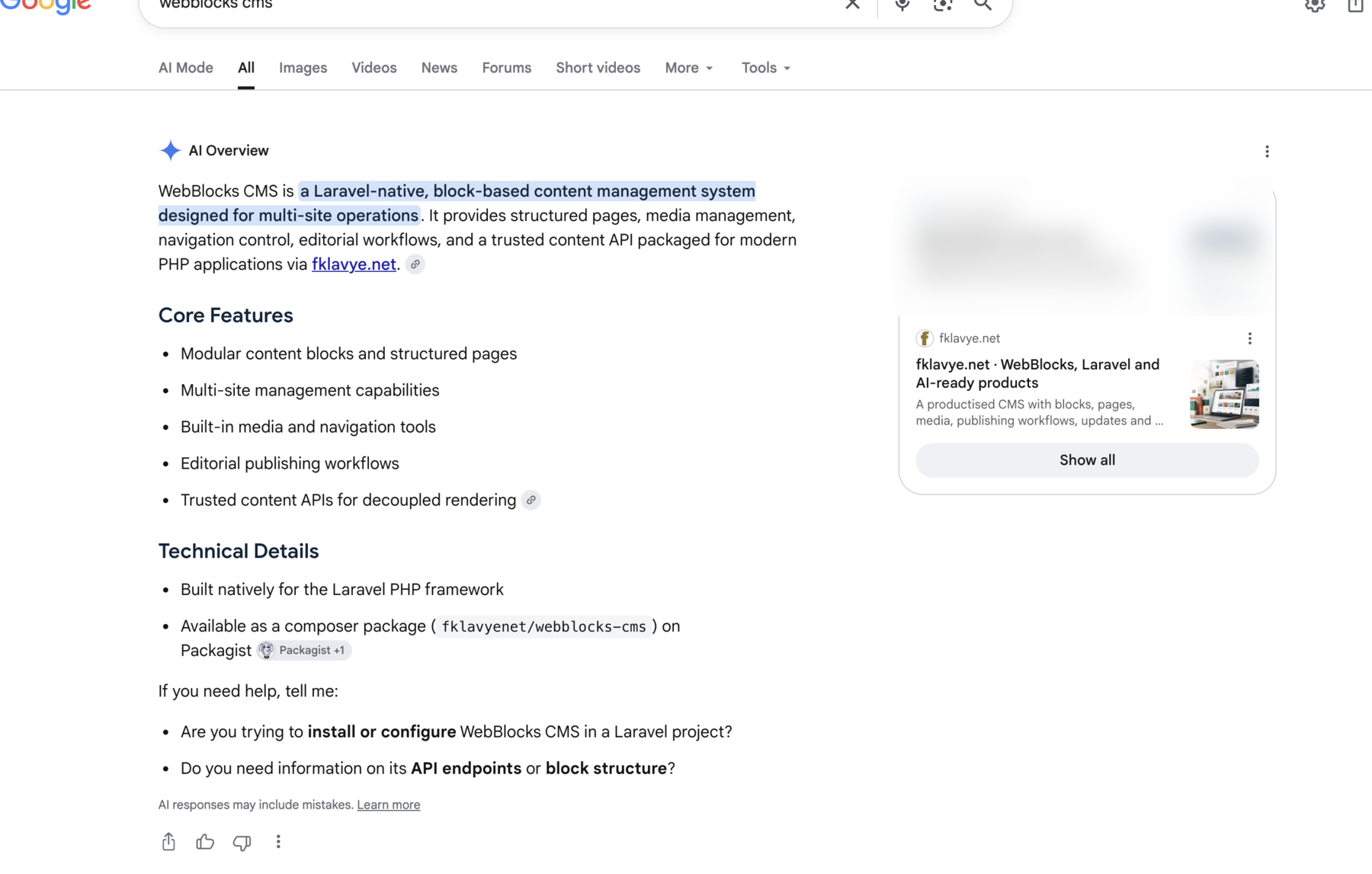
The journey began with the plain query webblocks cms in signed-out Google Search. Before a visitor opens our website, the search page already frames the product as a Laravel-native, block-based CMS for multi-site operations and lists structured pages, media, navigation, editorial workflows, and a trusted content API.
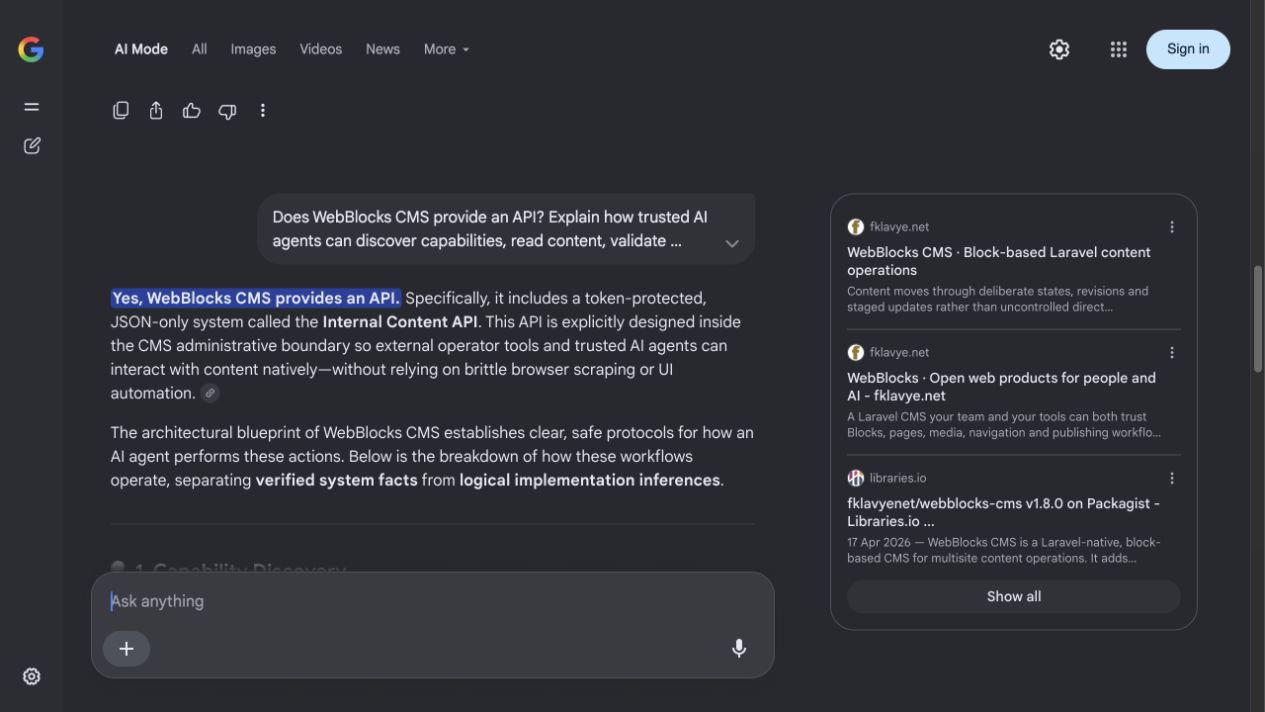
The next question was not sent to a fresh chatbot with a long product brief. It followed the search result in the same Google AI Mode journey: does WebBlocks CMS provide an API, and how can trusted agents discover, read, validate, draft, preview, and publish?
The answer identified the token-protected content API, discovery and contract surfaces, validation-before-writing, draft-first operation, rendering, and separately scoped publication. Those are claims a reader should verify in the linked product documentation; the value of the result is that the search system could assemble the operating model from public sources.
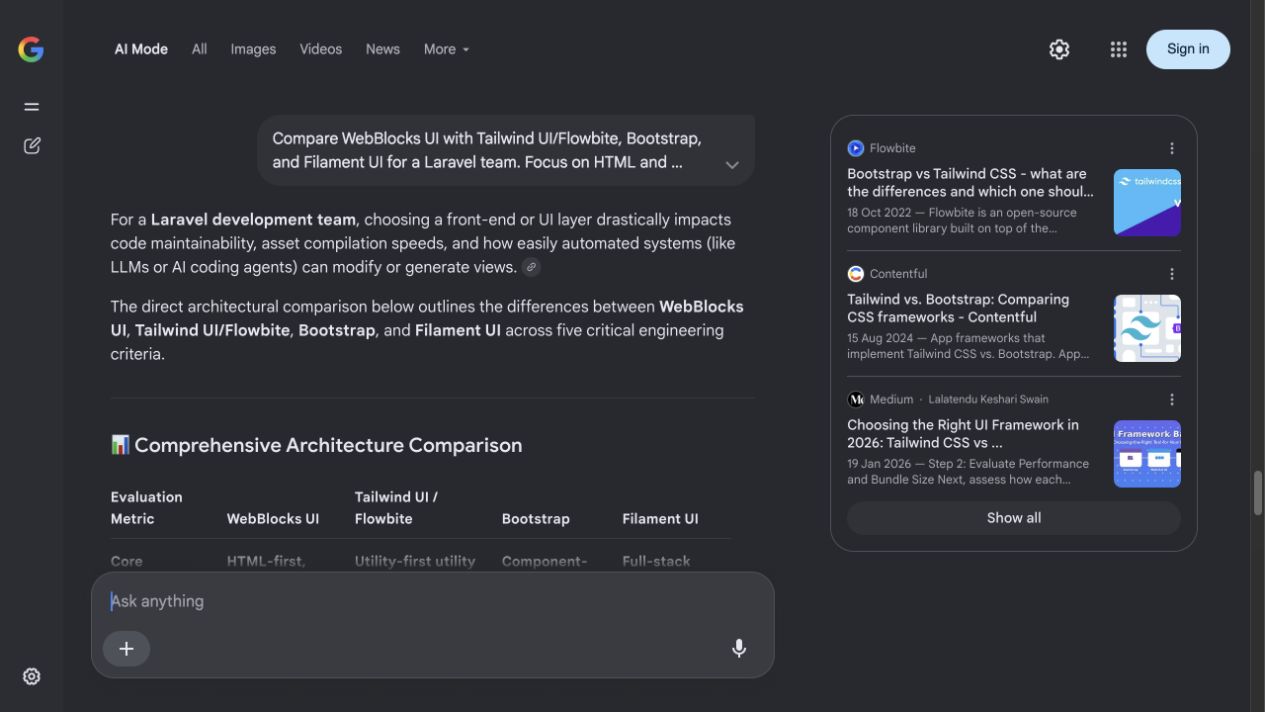
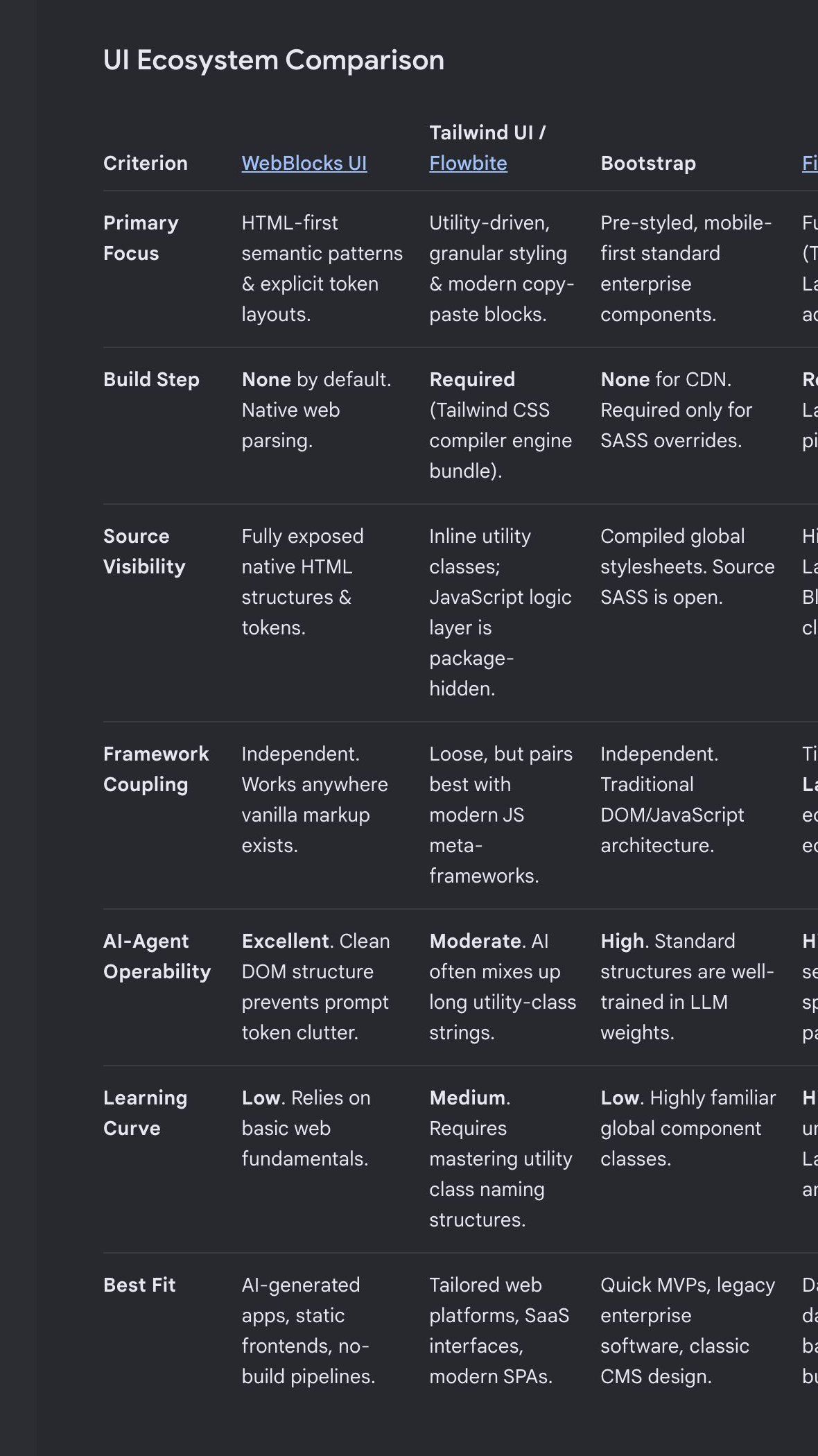
The conversation then moved to WebBlocks UI and a practical comparison with Tailwind UI/Flowbite, Bootstrap, and Filament UI. The requested criteria were source visibility, build steps, framework coupling, AI-agent operability, and when each option is the better fit.
The important part is not flattering wording. It is that a search journey beginning with a generic product query could continue into the intended relationship between the CMS, its API, WebBlocks UI, and trusted AI tools.
That is evidence that our public terminology is becoming coherent enough to retrieve. It is not evidence that every generated sentence is correct, that Google recommends the product, or that WebBlocks is already broadly adopted.
A good AI-ready product does not ask for blind trust. It makes capabilities, permissions, proposed changes, and publication state visible.
A tool learns what the system supports before it proposes a change.
Pages, blocks, fields, locales, and publishing states are explicit.
Reading, drafting, media work, and publishing can be authorized separately.
Changes can be validated and rendered as drafts before they become public.
HTML, content structure, and audit history remain understandable to people.
AI compatibility should not require replacing the open web with another black box. HTML-first interfaces give browsers, assistive technology, developers, search systems, and trusted automation a shared surface to inspect.
WebBlocks UI follows that direction through source-visible patterns, explicit design tokens, progressive enhancement, and no mandatory application framework. An agent can propose or adapt a component; a person can inspect the same result and decide whether it belongs in the product.
WebBlocks CMS treats content as structured pages and blocks, then exposes a controlled operating path:
This is deliberately less magical than asking an agent to “fix the website.” The boundaries are the feature.
Prospective users often meet an emerging product through search before they meet its documentation or community. Recording this journey gives them a dated, inspectable starting point and gives us a public standard to maintain: claims should remain consistent, verifiable, and linked to working product surfaces.
AI-ready software should become calmer software: fewer hidden assumptions, smaller permissions, clearer schemas, and safer hand-offs between people and tools.
WebBlocks UI keeps interface structure legible. WebBlocks CMS keeps content operations structured and controlled.
Necessary cookies are always on. Optional categories can be changed at any time.
Required for core site behavior.
Remember language and interface choices.
Measure usage and content performance.
Support campaign attribution and ad measurement.